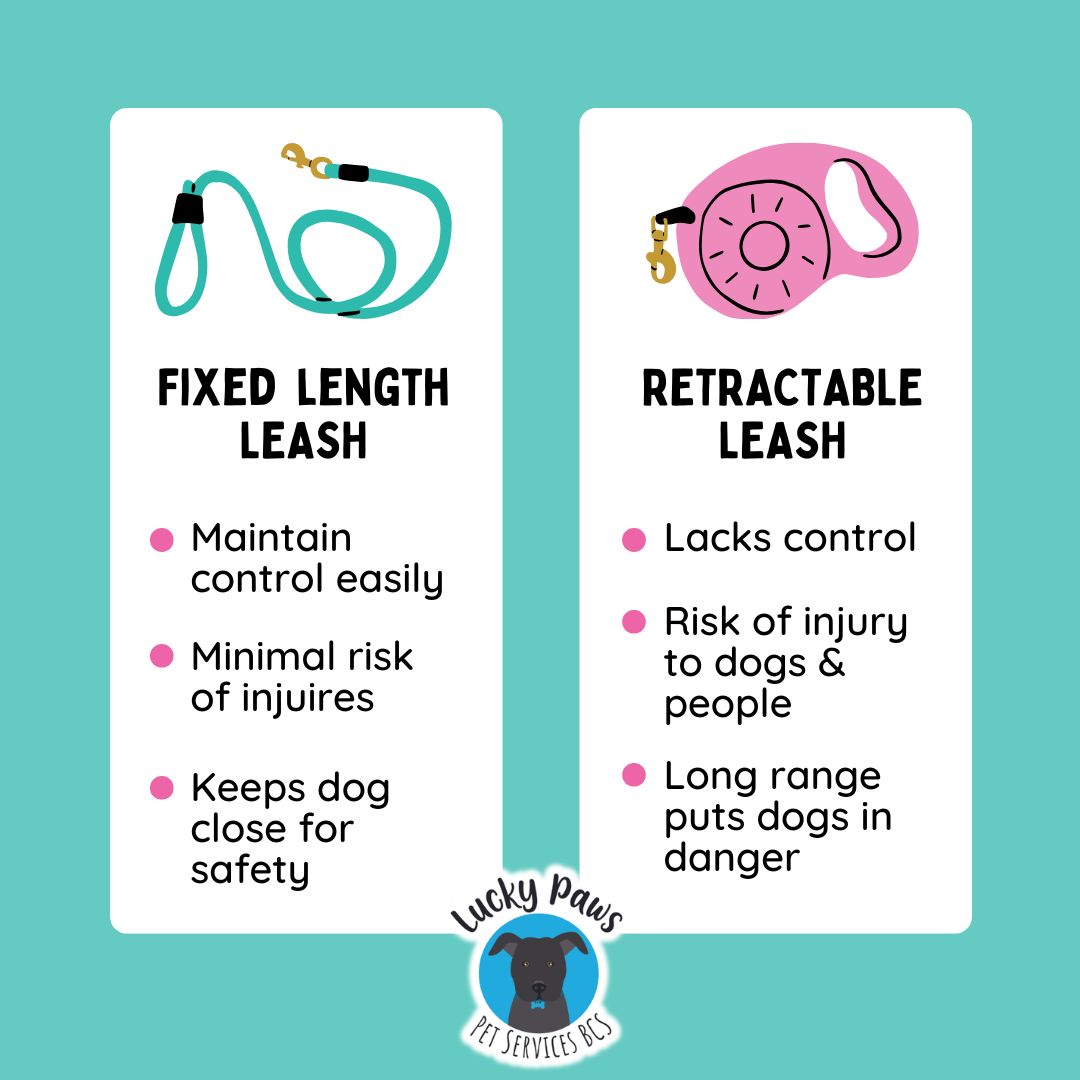
The Leash Lowdown: Fixed vs. Flexi — Choosing the Right Leash for Your Dog
As professional dog walkers, we see a wide variety of leashes in action. While we appreciate owners taking the initiative to keep their dogs safe and contained, we often encounter a common misconception about retractable leashes, also known as flexi-leads. Today, we're breaking down the differences between fixed-length leashes and flexi-leads, and explaining why we strongly recommend fixed-length leashes for everyday walks.
Fixed-Length Leashes: Reliable and Safe Control
Fixed-length leashes, typically made of nylon, leather, or rope, are the standard for a reason. They offer consistent control and communication between you and your dog. Here's why we love them:
Consistent connection: A fixed length means you always have a direct link to your dog. This is crucial for navigating busy sidewalks, encountering other dogs, or reacting quickly to unexpected situations.
Clear communication: A taut leash provides clear feedback to your dog, helping them understand boundaries and stay close. A loose leash, on the other hand, signals relaxation and freedom to explore within a safe radius.
Training benefits: Fixed-length leashes are ideal for training basic obedience commands like heel, sit, and stay. They allow for precise corrections and reinforcement.
Durability and reliability: These leashes are generally built to withstand regular, everyday use.
Flexi-Leads: Limited Control and Potential Dangers
Flexi-leads, with their retractable cord that can extend up to 26 feet, might seem like a great way to give your dog more freedom. However, they pose several safety risks:
Lack of control: The extended length makes it difficult to quickly reel your dog back in if they run toward traffic, another dog, or a person. This lack of control can lead to dangerous situations.
Injury risk: The thin cord can cause rope burns or tangles, for both dog and owner. If a dog bolts at the end of a fully extended flexi-lead, the sudden stop can cause neck or spinal injuries.
Training challenges: Flexi-leads encourage pulling, since the dog learns that pulling extends the leash. This reinforces bad habits and makes training more difficult.
Difficult handling in close quarters: Navigating crowded areas or narrow paths with a flexi-lead can be a nightmare — the extended cord can easily tangle around people, trees, or other obstacles.
Broken leashes: The internal mechanism of flexi-leads can break or malfunction, suddenly releasing your dog and putting them in danger.
When Are Flexi-Leads Appropriate?
Flexi-leads can be useful in specific, controlled environments, such as:
Recall training in a secure, open area: If you're working on recall in a large, fenced-in area with no other dogs or distractions, a flexi-lead can allow your dog more freedom while still providing some control.
Sniffing and exploring in safe, open spaces: In very specific circumstances, such as a large open field with no hazards, a flexi-lead may be appropriate for letting a dog explore and sniff.
Our Recommendation
For everyday walks, we strongly recommend using a fixed-length leash (4–6 feet is ideal) that's hands-free — either a shoulder strap or waist leash. It provides the best balance of safety, control, and communication, and it allows us, as professional dog walkers, to ensure the safety and well-being of every dog in our care.
Looking for the perfect hands-free leash setup? We swear by the Tiny Horse Leash System — so much so that all of our staff use them, and we're proud Tiny Horse Dog Walking Ambassadors. Check out their full lineup here and use our code LuckyPawsBCS for 10% off your order.
Disclosure: As Tiny Horse Ambassadors, we earn a small commission on purchases made with our link or code, at no extra cost to you. We only recommend gear our own team actually uses on the job.
If you have any questions about choosing the right leash for your dog, please don't hesitate to contact us. We're always happy to help!